Visiting UAx Platform Sister Schools - An Interview with Taras Lesiv, Rebecca Duclos, David Ross
Monday 18 March 2024
“UAx serves as a vital communication platform, especially during times of conflict. It's essential for us to engage in these processes, to listen and understand one another. It's what keeps us going.” - Taras Lesiv, Vice-Rector for Academic Affairs at the Lviv National Academy of Arts
ELIA UAx Platform Manager, Uliana Furiv, interviewed Rebecca Duclos, the Chair of the UAx Steering Committee and Professor of Art History at the Faculty of Fine Arts at Concordia University, David Ross, guest lecturer at the Estonian Academy of the Arts (EKA), and Taras Lesiv, Vice-Rector for Academic Affairs
at the Lviv National Academy of Arts (LNAA). In the autumn of 2023, Taras, Rebecca, and David visited the UAx Platform Sister Schools located in Ukrainian cities in Lviv, Kharkiv and Kyiv. The visit was organised by Taras Lesiv. In this interview Rebecca, David and Taras discuss their experiences in Ukraine during their visit. They highlight the importance of
in-person connection in times of conflict and understanding the reality of life for staff and students in Ukraine first-hand. Rebecca, David, and Taras also reflect on the biggest challenges that Ukrainian art schools currently face and the crucial
next steps for the UAx Platform.
Uliana: Given that the core group organising and visiting all these [UAx] schools from Ukraine consisted of the three of you, I believe it's important to delve into your experiences. It circles back to Rebecca highlighting the significance of archiving the project's important milestones. My initial question to all of you is: where did the idea of facilitating this visit come from?
Taras: I approached Rebecca about the possibility of her [and David] coming to Ukraine to teach a few classes or engage in conversations with our students at LNAA. She readily agreed, and from there, we began planning the trip.
Two weeks after my return to Lviv, I discussed the visit with the rector of LNAA (Vasyl Kosiv). Then we started drafting the schedule, ultimately deciding on a two-week duration for their visit. I took the initiative to outline the activities
for each day, both on weekdays and weekends. While the weekday plans were straightforward, we had to brainstorm ideas for the weekends. I suggested three options: exploring Lviv, visiting the nearby mountains or castles, or perhaps venturing
to other Ukrainian cities like Kyiv or Kharkiv, which are sister schools of other [UAx] institutions. Within 5 minutes I got the email: “yes, we would love to go wherever you take us”. It was very funny, because I knew they were aware of the
potential risks, yet they were eager to embark on the adventure. Interestingly, even my administration was hesitant about visiting Kyiv or Kharkiv. Nevertheless, we proceeded with planning this trip.
Uliana: Rebecca and David, why was it important for you to embark on this trip?
David: I think there's really something about just feeling things that are only communicated when you're in touch with people at a personal level. Things that are impossible to communicate in any other way. An example: en route
to Ukraine we were on a train in Poland, and there were, of course, lots of young men around us. I imagined that their biggest worry was whether their boss will give them a raise, or whether they will be able to pay rent, or that they should
not forget to text their girlfriend. However, our visit to Ukraine prompted a profound shift in perspective. Every time I saw a man under the age of 60 in Ukraine, I couldn't help but wonder how long it would be until he received the call
to defend his country. How long until his life changed? This shift in perception was significant. We gained a heightened sense of urgency and witnessed first-hand the enduring impact of ongoing tensions. We felt the palpable effect it had
on the daily lives of Ukrainians, similar to a pervasive illness. We feel compelled to convey this reality to others.
Rebecca: I also remember all these conversations and the emails. I remember having absolutely no hesitation – actually, I felt the opposite. I felt delighted that Taras himself would take time out of his work life and his family
life to accompany us. We were very grateful that he was ready to do this. It was funny that people both outside of Ukraine and in Ukraine kept asking – “don’t you worry about the risks?” And we said: if the Ukrainians are not worried, then
we are not worried. And then, I think the longer we spent in Ukraine, the more our Canadian and the Ukrainian dark humour started to make a dance. [Laughing] So we're like, “well, if we're meant to die, of course we want to die with you guys!”
It was hilarious. It may sound bizarre to make such joking calculations about mortality, but it felt strangely normal in the context of Ukraine. We didn't intend to offend anyone, nor were we offended by jests about mortality. It's one of
those things you must experience first-hand to truly understand. It's an indescribable feeling, one that's difficult to convey to others. We felt a similar distance a year and a half ago when the war broke out – or for you, when the full-scale
invasion began. While it was then a new experience for us in Canada that felt remote, Ukrainians had been enduring this confrontation with mortality for years. Our desire to better understand the intensity of feeling led us to places like
Estonia initially. Ultimately, it's about feeling like we're making a meaningful contribution, learning from others, and gaining insight from these situations, rather than remaining comfortably idle in Canada. We also witnessed how much Taras's
presence was valued by the UAx Platform partners. We recognised our role as just one piece of the puzzle. Observing the close relationships among rectors, vice rectors and administrative staff across Ukraine, I couldn't help but feel a tinge
of envy. I remarked to Taras that, for example, I hadn't met anyone from the Ontario College of Art Design in years. There's less of a sense of familiarity among us in Canada. And with you folks, there are hugs all around. [Laughing] And it's
unbelievable to realise the power that has been forming, and will continue to grow even more now with the UAx Platform, across Ukraine in these art academies who, together, represent a formidable number of creative practitioners and thousands
of students.
Uliana: Taras, was this your first experience of visiting multiple Ukrainian art schools in such a manner?
Taras: Yes, it was essentially my first time. I've visited Kharkiv and Kyiv before, but only their visual art academies. So, it was my first visit to these new [UAx] institutions. Thanks to the UAx Platform, we've truly come together
and are creating stronger connections. Despite residing in the same country and even sharing the Ministry of Culture, our institutions aren't as close as they should be. The UAx Platform has been instrumental in organising events like the
Artistic Research Symposium, facilitating easier communication and involvement of other institutions. We're even hosting a parallel
conference here, focused on doctoral programmes and artistic research development. We've invited guests from Nezhdanova Odesa National Academy of Music [one of the UAx schools] to participate and present alongside us. This level of collaboration
is unprecedented for us. UAx serves as a vital communication platform, especially during times of conflict. It's essential for us to engage in these processes, to listen and understand one another. It's what keeps us going. The visit from
Rebecca and David generated a lot of excitement. Given the lack of visitors to Ukraine since Covid and particularly after the full-scale invasion, their presence was significant. Specifically, their visit to Kharkiv held immense importance.
Lviv is relatively safe, and Kyiv draws many visitors due to its capital status. But a visit to Kharkiv? That truly mattered. As for David and Rebecca, I sensed genuine appreciation from the rectors, vice rectors, administrators, and staff.
They truly valued their visit.
Uliana: It's heartening to hear that by inviting Ukrainian art institutions into the ELIA network, we brought these institutions closer together. Reflecting on the visits to each of the UAx schools in Ukraine, what stood out to you the most?
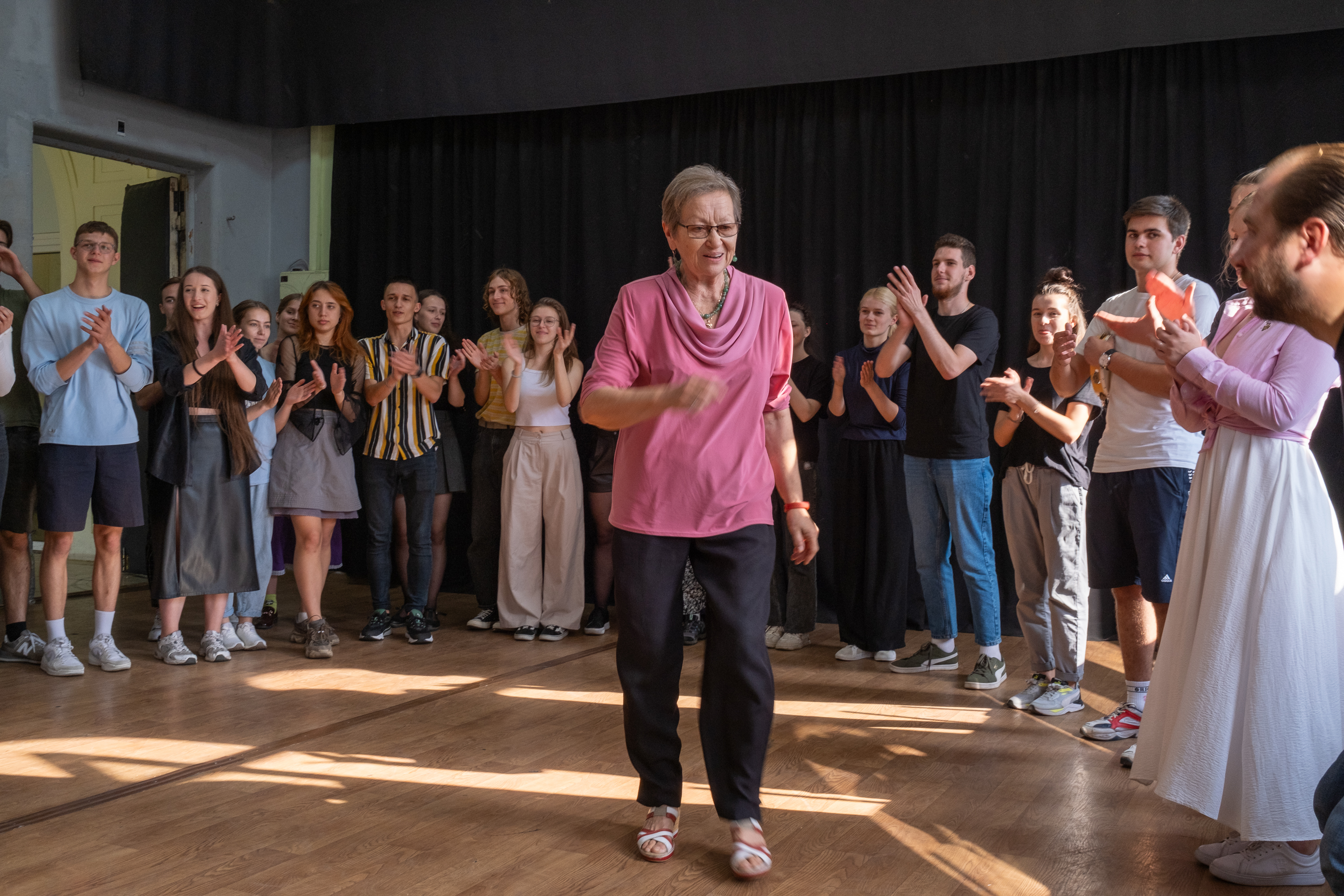
Rebecca: As we travelled together, particularly during our final day in Kyiv when we visited so many different schools – ranging across disciplines from from visual arts and architecture, to cinema, theatre, and television,
to music, to circus and performance – it was quite a journey. By the end of the day the diversity and range of Ukrainian arts activity was fascinating, ranging across traditional and experiential programs that had local, national, and
global aspirations. We experienced such a broad spectrum of experiences all in one day. Especially at the performing arts schools, there's a distinct difference – perhaps David and Taras can articulate this better than I can – in how you're
introduced to the environment compared to art and architecture schools. In the latter, you typically move from studio to studio, observing paintings and other works, and you may or may not encounter students actively working.
David: Sometimes, you may not find any students at all! [Laughing] Fine Art students are notoriously nocturnal.
Rebecca: Exactly! And if they are present, it's usually a situation of someone silently overseeing their work. However, when we visited the performing arts schools, it was a whole different experience. We stumbled into micro-concerts,
presentations, and rehearsals in every room. There were clarinet quartets, gymnasts performing routines – it was incredibly dynamic. This diversity highlighted how the UAx Platform is evolving [becoming interdisciplinary].
Taras: As for me, what stood out was meeting with the UAx Fellows. I didn't know the recipients of the
Abakanowicz Fellowship even in my own institution, prior to meeting them with Rebecca and David. I only knew one person previously from my institution. Initially, I was concerned whether they would be able to engage with Rebecca and
David, whether they wouldn’t be too reserved. I had these thoughts because I understand how challenging it can be for students to interact with foreigners in their institution. But once they met, conversations flowed effortlessly.
They shared their thoughts enthusiastically with Rebecca and David, and I realised these students were quite incredible. I also observed that the younger generation in Kharkiv and Kyiv is vastly different from my generation. [Laughing]
I even joked about feeling too old, as I couldn't imagine acting so confidently like these young people did when I was a student.
Uliana: What about you David?
David: I want to touch on something from our previous discussion, about remarkable differences between the art schools and their approaches. Coming from the visual arts milieu, especially Rebecca, who has spent considerable
time working administratively in art schools, it was fascinating for us to witness the various visual art schools in Ukraine and their distinct approaches to learning and knowledge dissemination. The teacher-student relationships, the
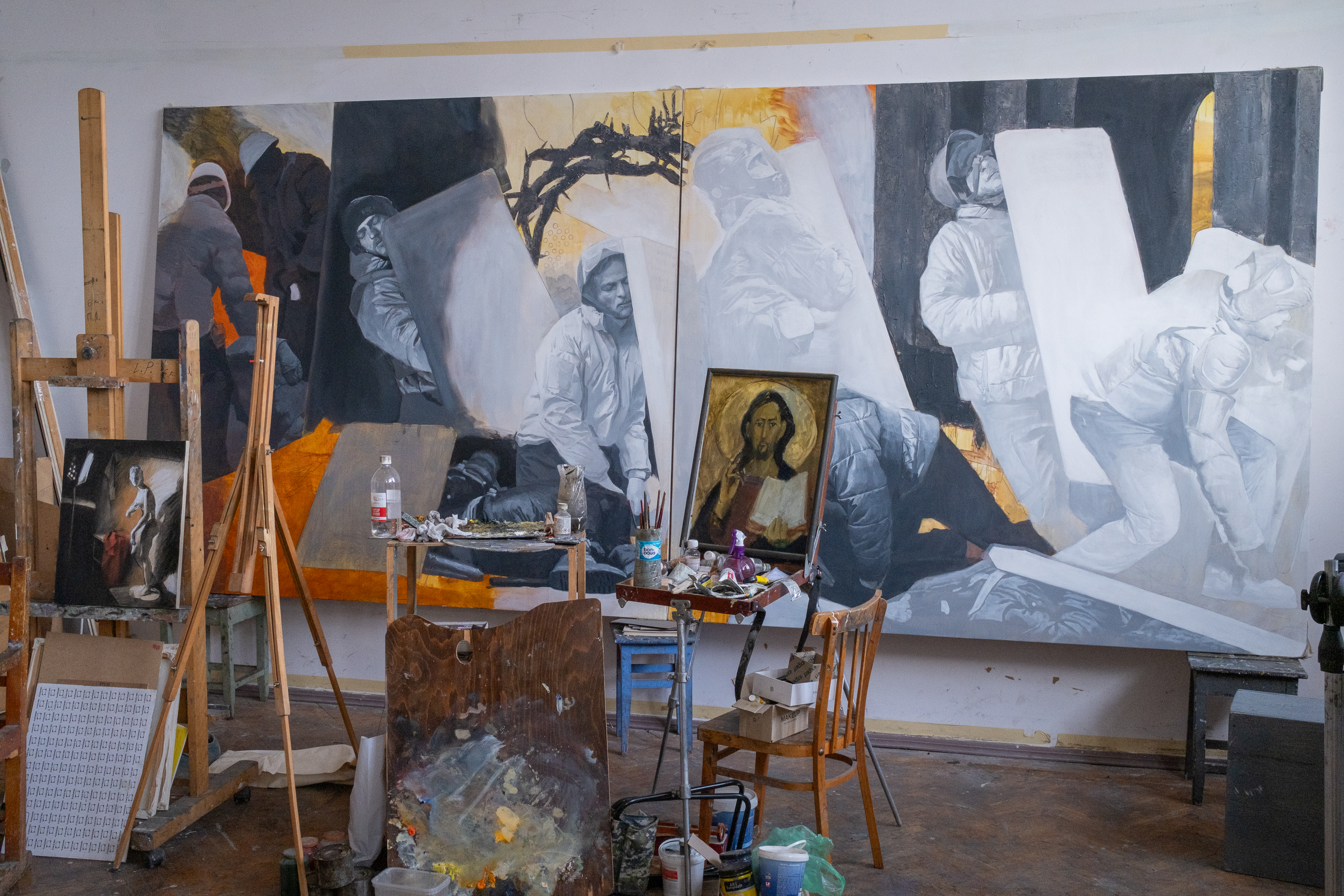
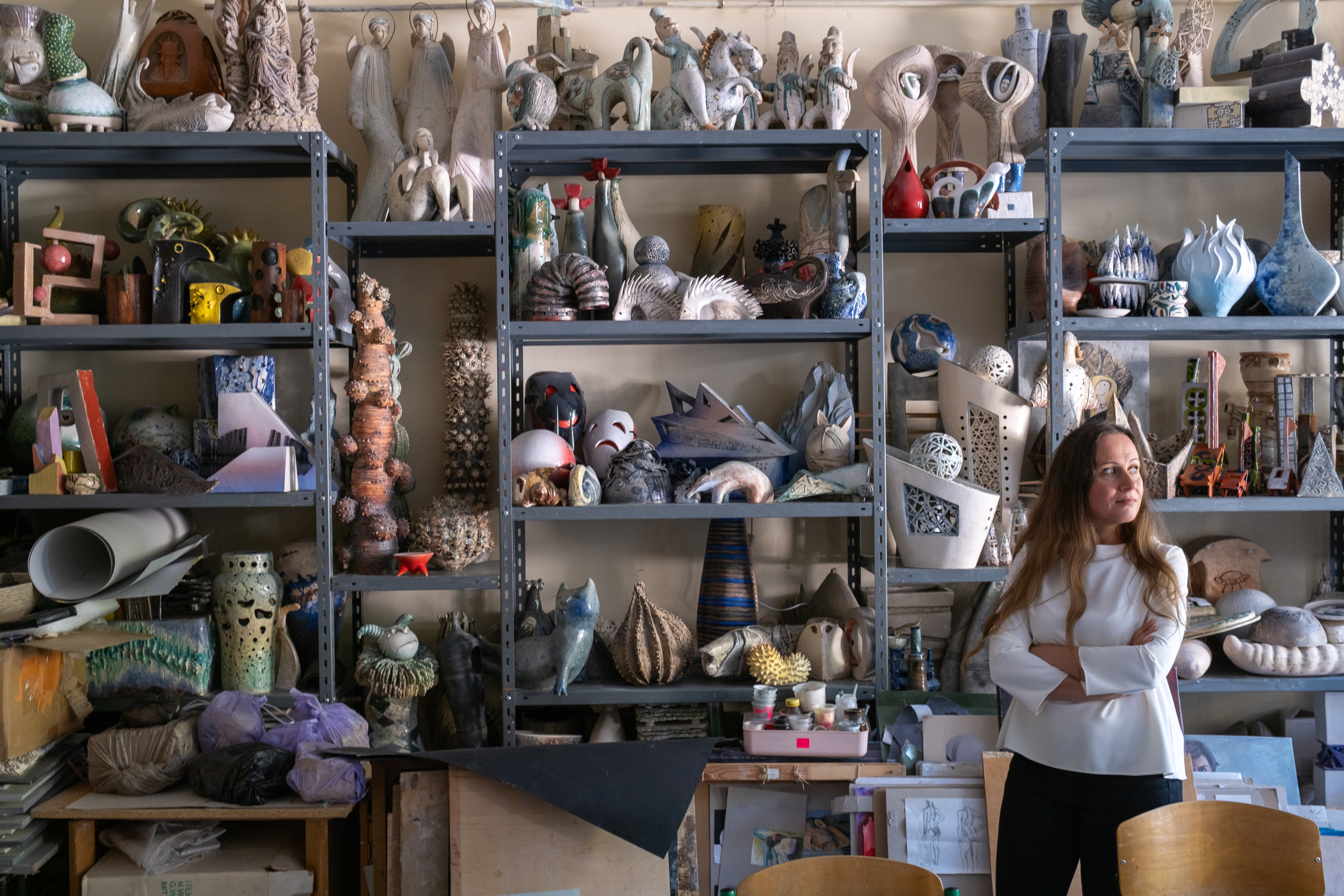
curriculum, the overall style – everything seemed different. It felt incredibly anachronistic. The role that observation plays — especially when it comes to rendering the human form, and life studies — is at a level I have never seen
in any school I’ve ever been in. Often, though not always, and not everywhere, the drawing, painting, sculpture we saw felt more classical than contemporary, more of the 18th or 19th century than the 21st. It's an incredible resource,
although not without its complexities from a “western” perspective. People simply don't create art like that in North American, or in European art schools. It was pure skill, and witnessing it was truly humbling, and startling, and thrilling.
Rebecca: This touches upon a conversation Dave and I had, before traveling to Ukraine. We were on one of the Estonian islands with some incredible artists and architects who were fascinated by the UAx project. They raised
a point that hasn't been addressed yet: they wondered if there was an intention to “Europeanise” the Ukrainian schools, as if the European system is inherently superior. Dave's point is crucial because this dinner table conversation
highlighted the need for reciprocity. We must seriously consider what Europe can learn from Ukraine in terms of traditions, styles, and teaching methods - which may seem “outdated” to a hyper-contemporary European mindset that leans
heavily towards conceptual approaches, problem-solving, practice led research, environmental concerns, sustainability. The pedagogical concerns in Europe differ significantly from those in Ukraine at the present moment. In this period
when a country has recovered from covid only to be plunged into a devastating invasion, where lies the radicality in anachronism? Perhaps there's a radical power in preserving heightened senses of observation, extreme skill, deep respect
for materiality, sensual subtleties, slow time, and a sense of self within traditional art forms, for example.
Uliana: This is perhaps a question for Taras. LNAA has a department of sacred art. I recall you mentioning once, Taras, that there isn't a single school in Europe which has a department like that. And you recalled an encounter when your rector, Vasyl, presented one of the paintings to the Pope. You said he was astonished that this tradition still exists. Given the fact that you are probably one of the last, if not the last, art schools in Europe doing that, do you feel pressure to "Europeanise" and abandon your traditional methods?
Taras: It's a good question. I don't believe we stand in the way of Europeanisation. When considering Ukraine's history, our academy was founded in the 1920s as a progressive institution following European traditions.
From our beginning we wanted to be named an academy, because it is associated to old-style European tradition of training students. We were quite an avant-garde academy, until Stalin started his repressions in the 1930s, disrupting
our progress. Many prominent artists were repressed, exiled, or killed. We were fully Europeanised before. Even during the Soviet era, there were connections with Western artists and institutions. Today, we're in a unique position
to learn from each other without merely copying one another. Just as American art evolved distinctively from European traditions in the 20th century, perhaps there's room for mutual invention rather than imitation between Ukrainian
and European educational systems.
Uliana: I know time is limited, so I’ll ask my last question. What do you think is the top priority for Ukrainian higher arts education in this state of crisis?
David: At its core, it's a matter of survival for these schools. We heard from Vasyl [rector] about faculty members practically working as volunteers due to reduced pay. It's becoming increasingly difficult to retain
faculty. There's financial pressure, with students potentially earning more freelancing for Western companies in a week than their faculty do in a month. Financial challenges are significant. I mean, I know that's not a very exotic
answer, I know that money can't solve everything, but I think that's obviously one of the big challenges.
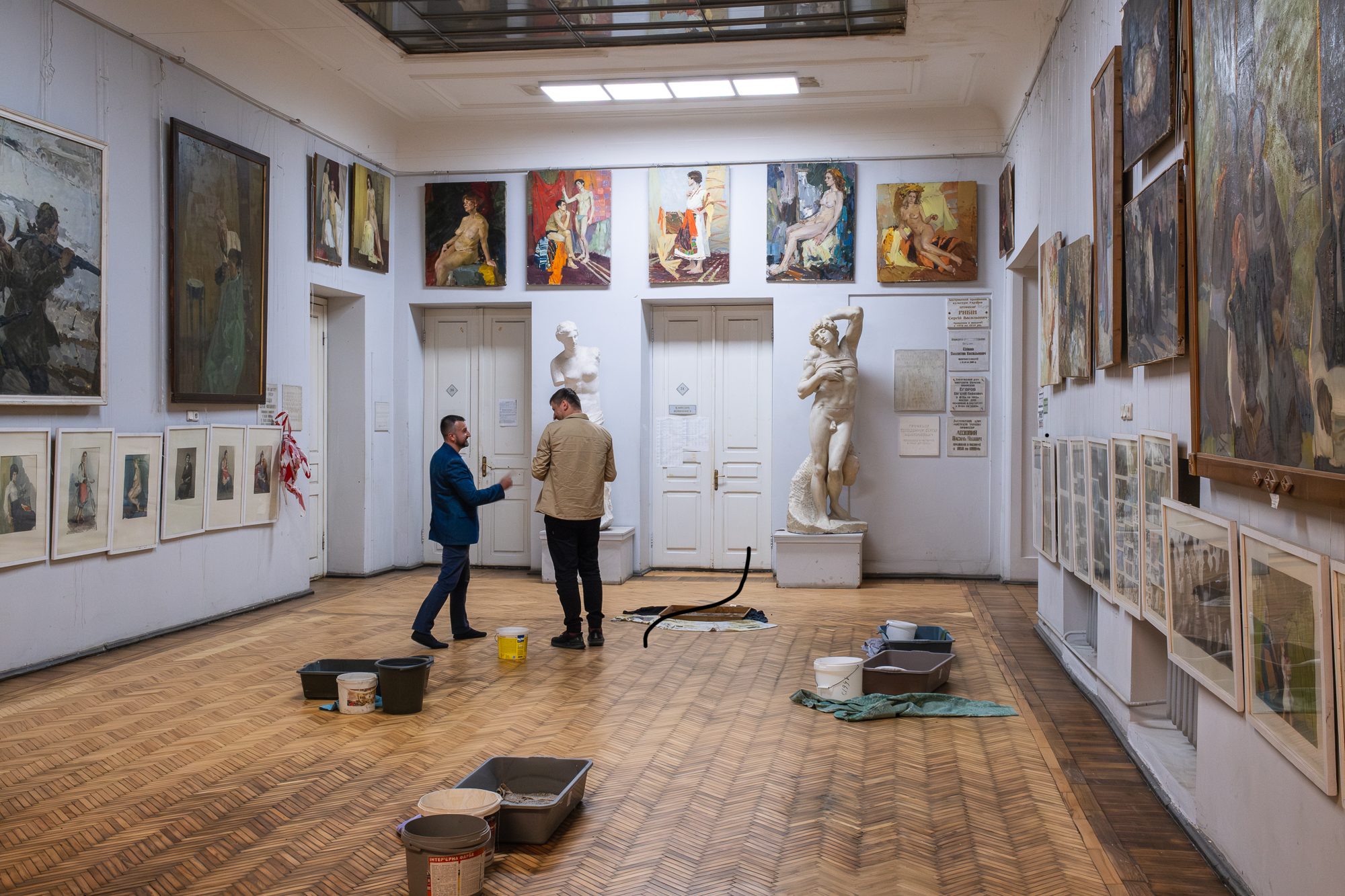
Rebecca: And on the topic of money as well, what was really apparent with the fundraising that LNAA is doing, is shelter conversion. For places like Kharkiv, it is essential due to the constant shelling. They can't
bring students back in any great numbers until there's a safe environment. So again, it's entirely unromantic. We were shocked to realise that there are government mandates about shelter usage, but no government funding to help
you convert your shelter. But if one does it interestingly, like Lviv is doing, it's not just a shelter conversion. It becomes an entirely new learning
space, a black box, and a community gallery. It's like building another building in a building that you already have. So that was one thing that was very striking to us – literally the art bunker as we're nicknaming it. Another
thing that I'm looking at is the longer-term perspective for higher arts education in Ukraine, and particularly its relevance in the reconstruction. I really don't want this to sound neoliberal, but the government of Ukraine is
going to have so many priorities that it will need to prioritise right away. And unless in the high arts education sphere we really get ourselves together and get our voices together and understand the new vocabularies of relevance,
this sector is going to be passed over. Because most governments, including the Government of Canada, the Government of the US, and many European governments, see the arts as a privilege and as a frivolous extra. All of us have
been fighting against this our whole lives, especially as practitioners, like Dave and Taras. And there is a way not just to talk about our students and alumni in terms of artistic production and the skills and needs and the technologies
that they learn, but there is another way also to talk about the artistic mindset. I'm still struggling with this, even in my own institution. It is about figuring out a lexicon and a vocabulary to describe the fullbody experience
of what these students learn. They learn to think with their hands. They learn to think critically. They learn to work collaboratively. They learn to be eloquent about reasoning. They learn to handle and solve problems very quickly.
There are all these other competencies that we don't talk about. And I think there's going to have to be preparation, knowing that there are some handouts that are going to be given, and unless we make the higher arts education
sector one of the relevant ones, we're all going to miss out. And Ukrainian society will miss out if the artists and designers and performers and arts educators are not part of the collective national future.
Uliana: Absolutely. It’s essential to emphasize the sector’s societal relevance.
Rebecca: Art therapy is a prime example of this clear relevance, but there are many other practices worth highlighting. After all, the country's leader, Zelensky, is an actor, and many skills from his acting career
directly contribute to his role in governance.
Uliana: Taras, what do you believe are the priorities for the higher arts education sector in Ukraine?
Taras: It's a significant question. I agree with what Rebecca and David mentioned about the importance of funding and capacity building, but I'd like to add another crucial aspect. We need more people like David and
Rebecca here. Their presence changes perceptions profoundly. We've seen this not just with them but also with Andres and Mihkel from the Estonian Academy of the Arts (EKA). Even a brief visit can transform understanding. When I
visited Kharkiv and saw the area of Saltivka, it changed my perspective dramatically. Photos can't convey the same depth of experience. Being physically present makes a substantial difference. So, we need more individuals like
Rebecca and David to come here.
Uliana: Rebecca, you've highlighted the relevance of national conversations on reconstruction, rebuilding and accessibility in Ukraine. Can higher arts education mobilise itself to actively participate in these areas?
Rebecca: The answer's yes, and I think it's also something that the UAx Platform can do. I'm also realizing that the platform had focused so much on connecting the Ukrainian and the European space. But now, having
been in Ukraine, I'm realising that the first priority is amongst the Ukrainian institutions themselves. I think it would bode well to get ahead of the conversation and anticipate having to create solidarity amongst them now,
before the governmental actions start to happen. In other words, I think a summit of the UAx Platform members and maybe even others in the higher arts education sector should be staged over two days in a safe part of central
Ukraine. And anybody that can get there should. And I think that the students should be involved. Maybe the Abakanowicz Fellows can even run this. If we really want to take this seriously, and we think about it intergenerationally,
we can let the students run a summit to which everybody's invited. And there would be 10 key points that everybody would try to reach some kind of consensus on, trying to imagine where they want to be in five years. I don't
know what that would look like, but I think that is something that could be very important. Like when we think of the performing arts, their concerns are different. I think everybody needs to have this discussion with each
other, because the concerns can be varied, but at least if they can be consolidated – with solutions, that can already go a long way. So that when the Ministry comes calling, there's not a single voice, but there's a polyphony
of voices that have already convened and focused their intentions. I think the Ministry will be shocked to realise that the academies across Ukraine have all been in the room together for a long time before they even started
asking questions.
Taras: I echo Rebecca’s points. I don't want to repeat what Rebecca said, but the idea of such events came from students. They just started to ask Rebecca whether it's possible to meet other Abakanowicz Fellows
and become part of a huge community. And that was interesting because it's not an idea which we came up with.
Rebecca: At one point Dave just looked at me and he said: “somebody should just throw €3000 at these students, give them a venue, and let them go, let them figure it out”. They'll do that. They will figure out
how many train tickets they need to buy, what kind of supplies they need, how much food they need. And I don't think it's a huge monetary investment, but it will produce astonishing results, even if they just get to know each
other socially. They don't need to solve all the problems right now. They can be just forming a community they're so excited about. And Taras is right, it came completely unprovoked. Every single place we went to and met Fellows,
they all said that to us.
Uliana: Yes, this kind of opportunity for them to connect would be very important. And quoting David: “if these students are the future generation of Ukraine, then I'm not worried about this country”.
Rebecca: It was said with genuineness! I remember hearing Dave say that.
Uliana: Well… this brings us to the end of our one-hour interview. There are so many more things that we could discuss, but let’s end it here. Thank you to all of you for your time and for insightful reflections. I am left
feeling hopeful. Thank you!
Photo descriptions:
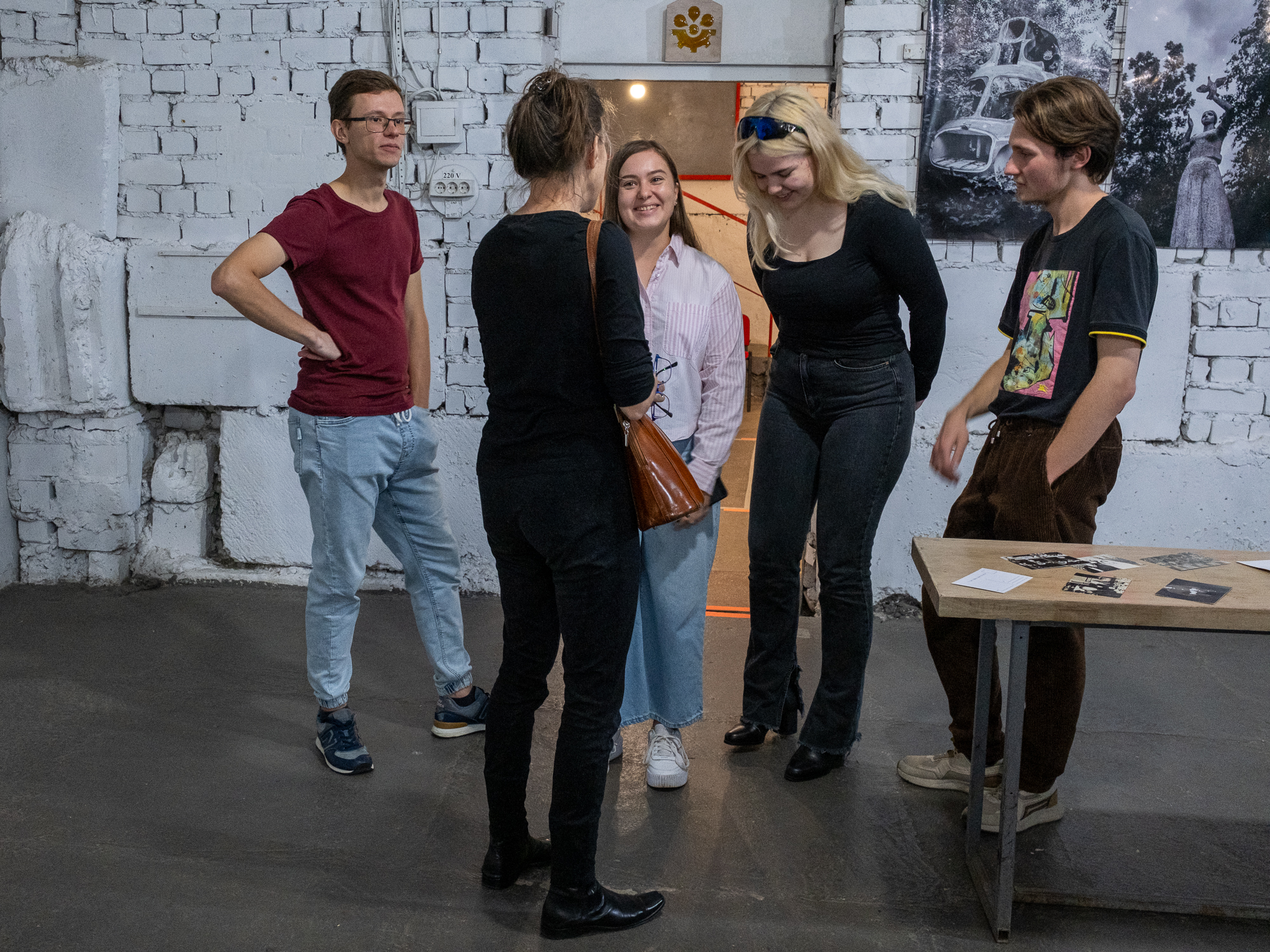
1. Magdalena Abakanowicz Fellows from the Kharkiv State Academy of Design and Fine Arts chat with Rebecca Duclos in the relative safety of the school’s bomb shelter.
2. Students and their instructor following a drama exercise at the I. K. Karpenko-Karyi Kyiv National University of Theatre, Cinema and Television, Kyiv.
3. Works by graduate students at the National Academy of Fine Arts and Architecture, Kyiv.
4. Works of art and water collection buckets greeted us in the Kharkiv State Academy of Design and Fine Arts. A Russian missile landed directly behind this building in 2022, blowing out most of the structure’s windows, including skylights, making it difficult to keep heat in and water out.
5. Olena Chepelyuk, rector of Kherson National Technical University during a tour of LNAA.
Photo credits: David K. Ross
|

 Email to a Friend